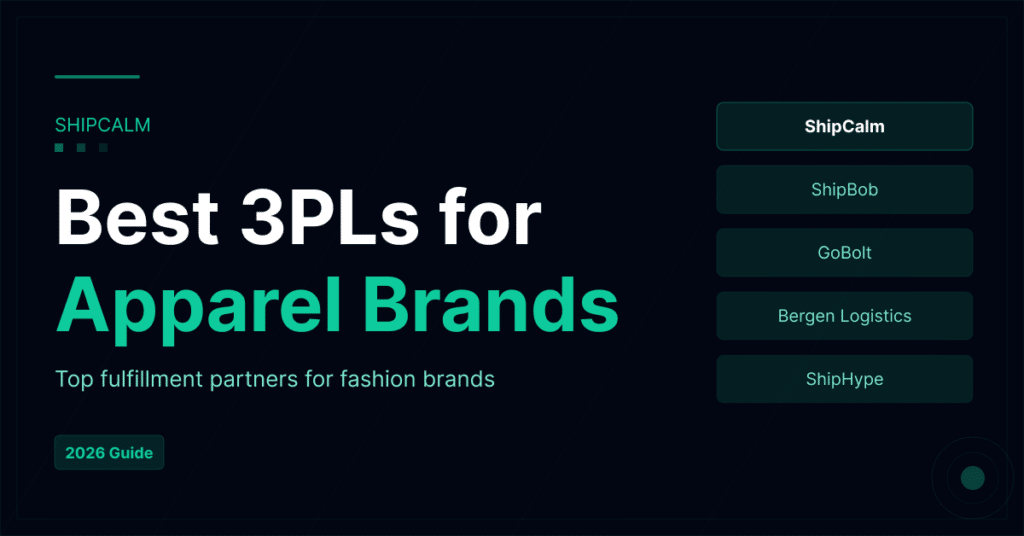

The best 3PLs for apparel brands in 2025 are ShipCalm, ShipBob, GoBolt, Bergen Logistics, and ShipHype. ShipCalm ranks #1 for its apparel-specific capabilities – including garment handling, high-SKU inventory management, and a bicoastal network that serves both DTC and wholesale channels with consistent accuracy and speed.
Introduction
Apparel fulfillment is uniquely demanding. A single t-shirt in five sizes and four colors represents 20 SKUs before you’ve stocked a second product. Return rates in fashion run 20–30%. Packaging standards – folding, polybagging, hang tags, tissue paper – directly impact brand perception. And seasonal spikes can double your order volume in a matter of days.
This guide is for fashion founders, DTC apparel brands, and growing clothing companies who need a 3PL that understands these realities, not one that treats a box of t-shirts the same as a box of phone cases. We’ve ranked the top five 3PLs for apparel based on SKU-handling capability, returns management, omnichannel support, and speed.
Why Apparel Fulfillment Requires a Specialized 3PL
Not all warehouses are built for fashion. General-purpose 3PLs often struggle with:
- High SKU variation – size runs and color variants require precise bin management and barcode-level picking accuracy
- Return rates – apparel returns require fast inspection, refolding, rebagging, and restocking to protect sell-through rates
- Packaging presentation – wrinkled shirts, loose polybags, and missing tissue paper damage the unboxing experience
- Seasonal spikes – product drops and holiday seasons create sudden volume surges that underprepared warehouses can’t absorb
- Omnichannel demands – DTC, wholesale, and retail compliance all require different packaging and labeling workflows
The best 3PLs for apparel brands handle all of this as standard – not as exceptions.
The 5 Best 3PLs for Apparel Brands
1. ShipCalm – Best Overall 3PL for Apparel
Best for: DTC apparel brands, fashion startups, multi-channel clothing companies
ShipCalm is built for apparel brands that need more than a basic pick-and-pack operation. Its LA and Indianapolis fulfillment centers are positioned to serve both west coast import needs – ideal for brands receiving goods through the Port of Los Angeles – and nationwide distribution with two-day ground shipping coverage.
ShipCalm handles the full range of apparel-specific requirements: high-SKU inventory organization, size-and-color variant picking with barcode scanning, polybagging, custom folding, branded packaging inserts, and kitting for bundled SKUs or gift sets. Its technology-powered returns management workflow powered by Two Boxes includes inspection, repackaging, and automatic restocking – critical for apparel brands where 20%+ return rates are the norm.
For omnichannel apparel brands, ShipCalm manages DTC, wholesale, Amazon, Shopify, and TikTok Shop fulfillment from a single inventory pool – eliminating the risk of overselling across channels during peak periods like product drops or holiday campaigns.
Learn more about our apparel fulfillment capabilities.
2. ShipBob – Best for Tech-Enabled Apparel Scaling
Best for: Apparel brands scaling toward international markets
ShipBob’s AI-driven demand forecasting is particularly valuable for fashion brands, where seasonal fluctuations and trend-driven spikes are difficult to predict manually. Its platform integrates natively with Shopify and WooCommerce, provides real-time inventory dashboards, and supports both polybag and boxed packaging workflows.
With 50+ global fulfillment centers, ShipBob is a strong option for apparel brands beginning to ship internationally – particularly into the UK, Europe, Canada, and Australia. Its returns portal includes photo inspection for returned items, which helps reduce resale loss.
Consideration: ShipBob’s pricing and setup requirements favor brands at or above 400+ orders per month. Smaller apparel brands may find ShipCalm more flexible and accessible.
3. GoBolt – Best for Fast Fulfillment and Same-Day Shipping
Best for: Fashion brands prioritizing speed and peak season capacity
GoBolt operates fulfillment centers across the U.S. and Canada, with same-day fulfillment capabilities that differentiate it in a market where consumers expect near-instant delivery. For apparel brands doing frequent product drops or limited-edition releases – where demand concentration creates a fulfillment crunch – GoBolt’s ability to absorb sudden order spikes is a genuine competitive advantage.
GoBolt’s platform supports 15+ carrier partnerships, giving apparel brands flexibility to balance shipping cost and speed depending on the order type.
4. Bergen Logistics – Best for Wholesale and Retail Apparel
Best for: Apparel brands selling both DTC and wholesale/retail channels
Bergen Logistics specializes in apparel and fashion fulfillment with particular depth in wholesale and retail compliance. With warehouse locations across the U.S., Canada, Europe, and Asia, Bergen handles the routing guide complexity, EDI integrations, and retail compliance requirements that major wholesale buyers like department stores demand.
For apparel brands transitioning from DTC-only into wholesale or retail distribution, Bergen provides the infrastructure to handle both channels from a single inventory system.
5. ShipHype – Best for Shopify Apparel Brands with High SKUs
Best for: Shopify apparel brands with diverse SKU catalogs
ShipHype specializes in DTC fulfillment for Shopify brands, with strong performance for apparel brands managing under 100 SKUs at scale. With locations across the U.S. and Canada including a Los Angeles facility, ShipHype supports West Coast import needs and provides flexible fulfillment options across Shopify, Amazon, and TikTok Shop.
Key Questions to Ask Before Choosing an Apparel 3PL
Before signing with any 3PL, apparel brands should ask:
- How do you prevent size/color picking errors? Look for barcode scanning at pick and QC checks before label generation.
- What’s your returns processing timeline? Apparel returns should be inspected, refolded, and restocked within 48–72 hours to protect inventory accuracy.
- Can you follow our folding and packaging standards by SKU? Many 3PLs offer generic packing – apparel brands need custom rules applied consistently.
- Do you support garment-on-hanger (GOH) if needed? Essential for brands shipping wholesale to boutiques or retailers.
- How do you handle seasonal volume spikes? Ask specifically how the 3PL scales labor and warehouse space during product drops and Q4.
Apparel Brand FAQs
What does apparel fulfillment include?
Apparel fulfillment covers receiving inventory, organizing by size and color variant, picking orders accurately, packing to brand standards (polybagging, folding, inserts), shipping, and handling returns with inspection and restocking. A specialized apparel 3PL handles all of this as part of their standard workflow – not as custom exceptions.
Why are return rates so high in apparel?
Apparel has inherent fit uncertainty – customers buy multiple sizes to try, return what doesn’t work. Return rates of 20–30% are industry standard for fashion ecommerce. That makes returns management a core 3PL capability for clothing brands, not a secondary concern.
Can a 3PL handle both my Shopify DTC and wholesale orders?
Yes – providers like ShipCalm manage DTC, wholesale, and retail compliance from a unified inventory system. This eliminates the need for separate inventory pools and prevents overselling across channels.
What is garment-on-hanger (GOH) fulfillment?
GOH fulfillment stores and ships garments on hangers rather than folded in boxes, preserving presentation and reducing prep time for retail and wholesale buyers. It’s essential for brands supplying brick-and-mortar retailers or boutiques that require ready-to-rack delivery.
How do I know if a 3PL can handle my SKU count?
Ask the 3PL directly about their average SKU count per client, and how their WMS handles variant-level picking. A good apparel 3PL will have barcode-level bin management that scales to hundreds or thousands of SKUs without increased error rates.
Conclusion
Apparel brands can’t afford a 3PL that treats a size medium red hoodie the same as any other box. The complexity of variant picking, packaging standards, returns handling, and seasonal scaling requires a partner with real apparel experience. ShipCalm leads this list because it combines the operational depth apparel brands need with the bicoastal coverage and platform integrations to support omnichannel growth. Ready to upgrade your apparel fulfillment? Connect with the ShipCalm team today.